How luxury watch brands are reinventing the art of marquetry, from Hermès to Patek Philippe

Hermès gets cheeky with horsehair, Patek Philippe and Chopard turn to traditional materials, and Ulysse Nardin uses silicon as an artistic medium
The artisan went on to explain that for one dome clock, he had cut 2,191 veneer parts of different colours, textures and veining to build an extremely detailed motif of sea, buildings, boats and birds. Imagine 50 shades of beige combined into one harmonious masterpiece – that is the ref. 21000M-001 Geneva Harbor, Patek Philippe’s first dome table clock made with wood marquetry.
First practised in Egypt and Anatolia and distinctively developed by Italian artisans during the Renaissance, the art of marquetry continues to evolve and find new expressions in cutting-edge examples within the watch industry. The practice itself involves preparing and meticulously layering fine veneers and delicate pieces of material to create intricate decorative patterns.

The base of the dial is made of ethical gold and the hexagons are glued one by one to the surface. Subtle variations in thickness, orientation and tone create a vivid, textured pattern, with no two dials identical. Each of the eight limited edition pieces is then finished with a lustrous wood-wax coating that enhances the play of light.
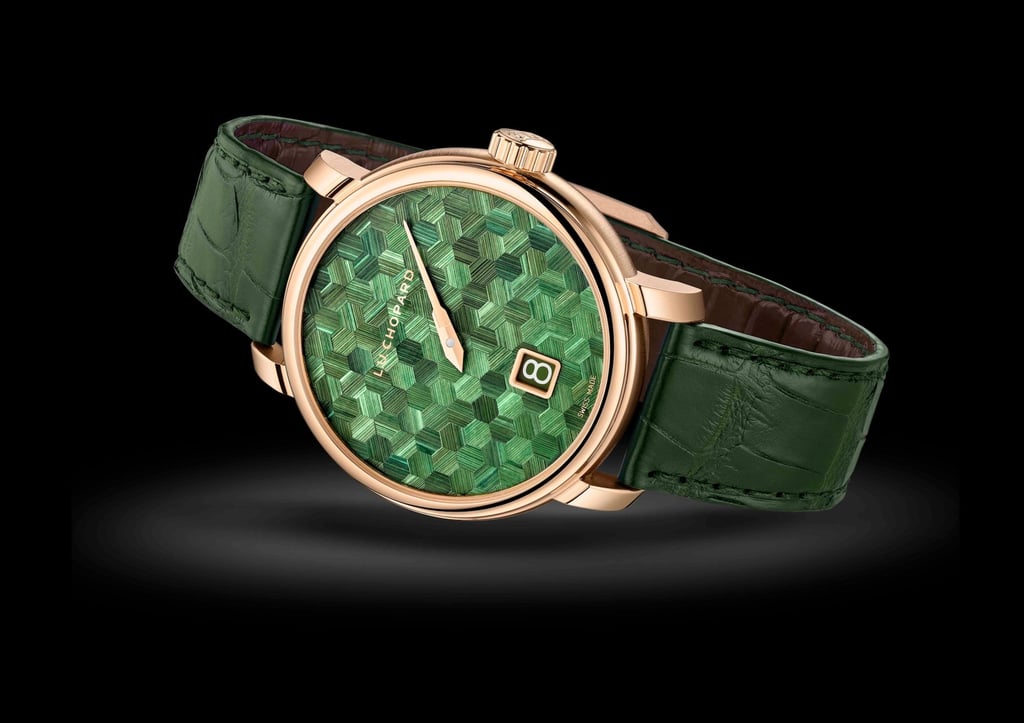
The hexagonal motif is no coincidence – it’s a nod to the beehive, a recurring symbol chosen by co-president Karl-Friedrich Scheufele for the L.U.C collection since 1997.
As Scheufele notes, a beehive and a watch manufacturer share intrinsic values: collaboration, precision and industrious craftsmanship.
For a more humorous application of the métiers d’art, the Hermès Arceau Rocabar de Rire is a 12-piece limited edition that plays with storytelling in its craftsmanship: the engraved, micro-painted horse on the dial side sticks out its tongue when the pusher at 9 o’clock is pressed.