Advertisement
PostMag
Life.Culture.Discovery.
Chinese history
MagazinesPostMag

The Chinese who built America’s Transcontinental railroad are recognised, at last

  • The First Transcontinental Railroad changed America forever, but thousands of men who had toiled on the tracks were erased from history
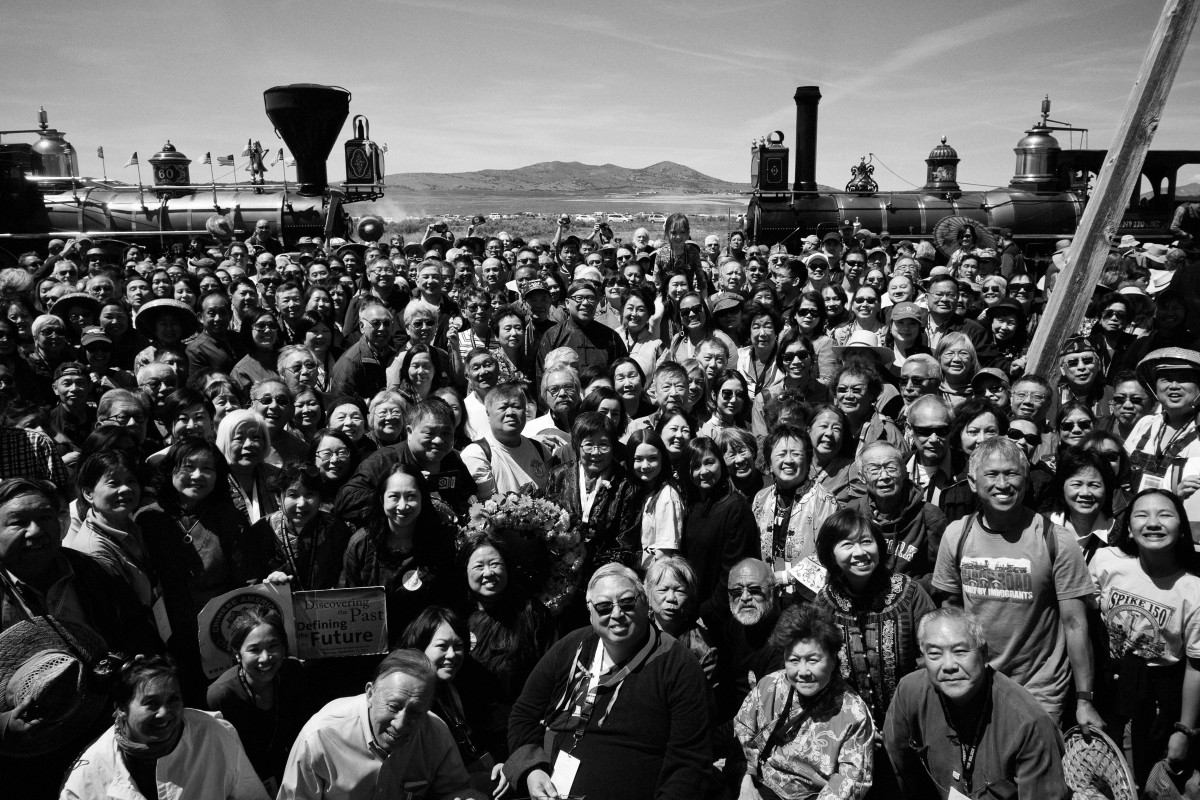
  • On the 150th anniversary of its inauguration, hundreds of Chinese-Americans gather in Utah to set the record straight
Reading Time:5 minutes
Why you can trust SCMP
New York photographer and activist Corky Lee’s 2019 reenactment of the iconic 1869 photograph, but with the descendants of Chinese railroad workers and other Chinese-Americans. Photo: Alan Chin
Alan Chin

Connie Young Yu has put forward her arguments many times. Having been invited by the United States’ National Park Service to celebrate the 150th anniversary of the inaugur­ation of the First Transcontinen­tal Railroad, the writer and historian stands on stage in Promontory Summit, Utah, before 20,000 people, and opens the commemor­a­tions: “My great-grandfather, Lee Wong Sang, was one of the thousands of unsung heroes, building the railroad across the Sierra Nevada mountains, laying tracks through to Utah, uniting the country by rail.

“Many descendants of Chinese railroad workers are here today. This is a far cry from 50 years ago. [Then], my mother, Mary Lee Young, was the only such descendant present. Yet why were the Chinese denied their rightful place in history at the 100th anniversary?” Yu asks.

“Why was Philip Choy, president of the Chinese Historical Society of America, kept from making a presentation on the official programme?”

Advertisement

Choy, who was also an architect, was in attendance at the 1969 ceremony but was denied the five-minute address to the audience he had been promised, in which he planned to acknowledge the contribution made by Chinese labourers. It is said that his slot was instead given to actor John Wayne.

“Because the contribution of the Chinese to the Transcontinental was kept from national memory,” Yu says, answering her own question. “The Exclusion law of 1882 stopped the immigration of Chinese labourers, and denied all Chinese naturalisation to US citizen­ship.”

Advertisement
The iconic photograph taken by Andrew J. Russell on May 10, 1869, in Promontory Summit, Utah, after Leland Stanford, president of the Central Pacific Railroad Company of California, ceremonially drove in the railway line’s golden Last Spike. Despite as many as 15,000 Chinese having worked on the railroad, none are pictured. Photo: Andrew J. Russell

The Chinese Exclusion Act was followed, in 1892, by the Geary Act, which was still more draconian and demonstrated the lengths to which authorities would go to expunge Chinese people from the American experience. Not only were no more Chinese labourers allowed to immigrate to the US, those already in the country were told they had to carry at all times a resident’s permit.

Advertisement
Select Voice
Choose your listening speed
Get through articles 2x faster
1.25x
250 WPM
Slow
Average
Fast
1.25x