
-
Advertisement
Lessons from China's history
LifestyleChinese culture
Wee Kek Koon

Reflections | What Iran’s former crown prince can learn from an exiled royal’s plea to Chinese emperor

A Persian prince’s attempts to restore his family’s throne from abroad highlight how political legitimacy is tough to forge in faraway lands

3-MIN READ3-MIN
1
Listen
Reza Pahlavi, the exiled former crown prince of Iran, calls for regime change in Iran in Washington in 2026. For years, he has sought to cast himself as a unifying figure for opponents of the Islamic Republic. Photo: EPA

In a recent interview, Reza Pahlavi, the former crown prince of Iran who is living in exile in the United States, described the death of the country’s supreme leader, Ayatollah Ali Khamenei, as a moment that could mark the end of what he calls a monstrous era of repression. Many Iranians, he said, greeted the news of Khamenei’s assassination with elation, sensing a rare chance to reclaim their country.

Pahlavi is careful to insist that he does not seek to be king or president, but a transitional figure who will guide Iran towards democracy. He has also called for Iran’s nuclear programme to be “totally dismantled”.

For years, he has sought to cast himself as a unifying figure for opponents of the Islamic Republic.
Advertisement
His visibility rose during waves of protests earlier this year in Iran, yet it remains unclear whether he commands enough support within Iran to make his leadership viable in any post-regime-change scenario, if such a moment materialises at all.
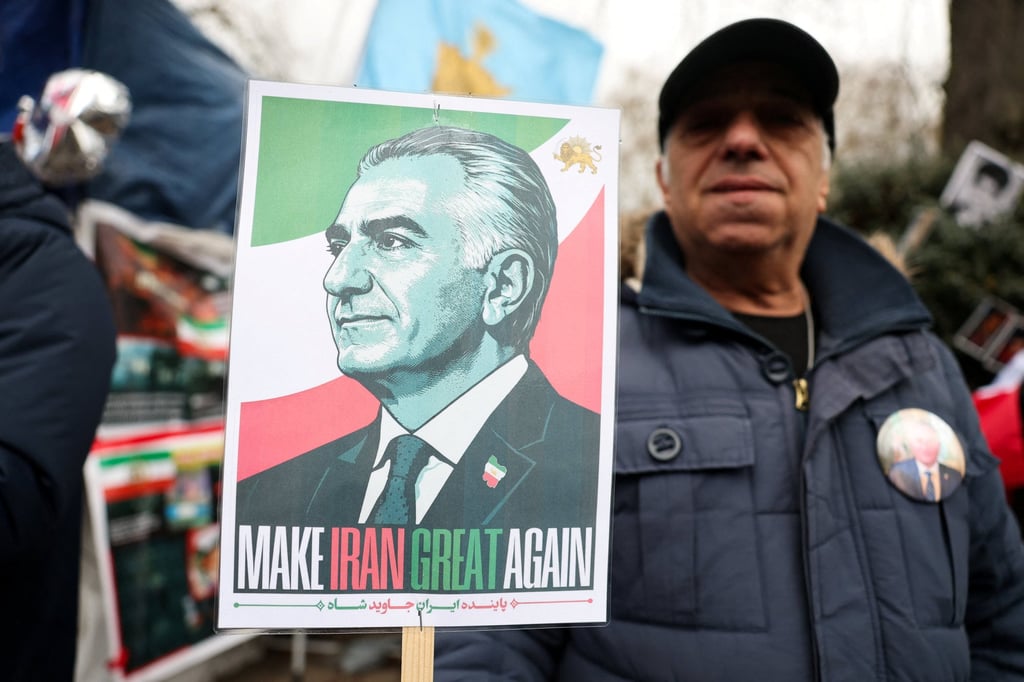
A man holds a placard depicting Reza Pahlavi as demonstrators gather in support of military action against the Iranian regime, outside the Iranian embassy in London, in February 2026. Photo: Reuters

Pahlavi is not the first exiled royal from that part of the world to imagine a return. Fourteen centuries ago, another Persian prince aspired to do the same.

Advertisement
In the seventh century, the collapse of the Sasanian Empire (224-651) coincided with the rise of the Tang dynasty (618-907) in China. At the centre of this geopolitical overlap stood Peroz, son of the last Sasanian ruler, Yazdegerd III, and heir to a dynasty that had ruled Persia and large swathes of West Asia for more than four centuries.
Advertisement
Select Voice
Select Speed
1.00x