Advertisement
Climate change
Opinion
Vibhuti Garg

Opinion | Amid global climate crisis, G20 nations need to commit to phasing out coal

  • Building new coal plants locks the region into higher carbon emissions and energy costs for decades
  • A G20 ‘no new coal’ pledge can be the first critical step to averting climate disasters and building the green energy infrastructure the region needs

Reading Time:3 minutes
Why you can trust SCMP
12
A delegate is seen at the G20 environmental and climate sustainability ministers’ meeting in Chennai on July 28, where ministers failed to agree on targets to reduce emissions and accelerate the energy transition. Photo: AFP
After a summer of unprecedented heatwaves, intensified by climate change, Group of 20 leaders are set to meet this weekend for the G20 summit in New Delhi, India. UN Secretary General Antonio Guterres has warned that time is running out as the world inches closer to meltdown, and called on all countries to accelerate action to cut emissions.
But while the G20 is responsible for around 80 per cent of global carbon emissions, and was founded to enable the necessary coordination to prevent world crises, leaders are not expected to deliver any substantive progress on emissions reductions at the summit.
Fast-growing G20 heavyweights, including China, India and Indonesia, have argued that the cost of aggressively cutting emissions is simply too high and stiff targets would hamper economic development. But these arguments are getting weaker. The cost of onshore wind and solar power has fallen below the cost of coal power, with offshore wind on a par with coal, according to BloombergNEF analysis.
Advertisement

A report by energy think tank Ember, the Centre for Research on Energy and Clean Air, and the Institute for Energy Economics and Financial Analysis found that solar generation helped seven Asian countries avoid at least US$34 billion in fossil fuel costs in the first half of 2022.

Governments across the region recognise that the development of renewable energy is the key to future prosperity. The Indian government plans to add 250GW of renewable energy capacity in the next five years to achieve its target of 500GW of clean energy by 2030.

Advertisement

This year alone, China aims to add a whopping 160GW of solar and wind energy capacity. It aims to bolster its position as a global renewable energy leader and is on track to reach its 2030 goal of 1,200GW wind and solar capacity five years early.
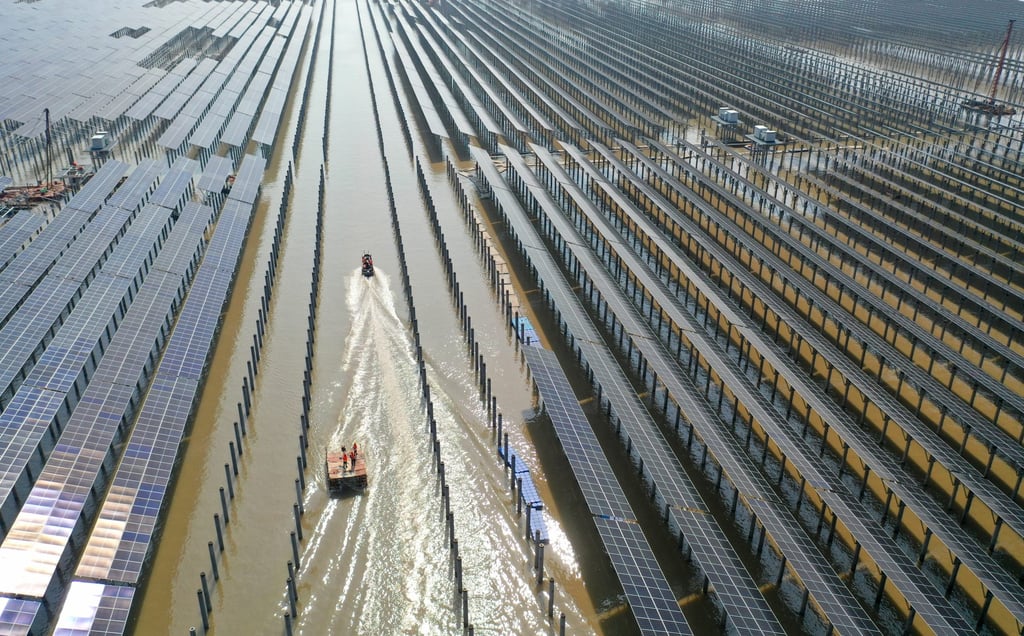
The construction site of a solar energy project is seen in Taizhou city, Zhejiang province, on August 17. At the end of July, the installed capacity of clean energy in Zhejiang had reached 57.51 million KW, surpassing that of coal power units for the first time. Photo: Xinhua
Advertisement
Select Voice
Choose your listening speed
Get through articles 2x faster
1.25x
250 WPM
Slow
Average
Fast
1.25x