Advertisement
.jpg?itok=27amKM0E&v=1666489668)
Opinion | Worrying revival of interest in nuclear weapons in China and South Korea
- The narrative is changing in China as its nuclear programme is increasingly tied to national rejuvenation, and in South Korea where there is overwhelming support for a nuclear defence against the North
- The value of nuclear restraint needs to be promoted and supported to avoid greater insecurity
Reading Time:4 minutes
Why you can trust SCMP
10

With loose Russian nuclear talk grabbing the headlines of late, North Korea’s military activities have largely gone under the radar. Yet Kim Jong-un’s dogged pursuit of missile and nuclear capabilities continues apace, with “tactical” cruise missile tests in recent weeks, and a seventh nuclear test expected soon – its last test was in 2017.
No magnifying glass is needed to appreciate the dismal state of nuclear politics in Northeast Asia. Yet this was not inevitable. In the 1980s and 1990s, the region was on a restrained nuclear path. Back then, China actively practised the nuclear minimalism it preached, joining deals such as the Nuclear Non-Proliferation Treaty and Comprehensive Test Ban Treaty. US president George H.W. Bush even opted to remove US nuclear weapons from allied Asian soil, including South Korea.
Unfortunately, three decades on, there is a revival of interest in nuclear weapons within Northeast Asia. This revival is clearly visible in China, where a build-up of strategic forces is under way.
Advertisement
The discovery of new missile silo bases last year, the mass development of dual-use missiles (for nuclear or conventional strikes) such as the DF-26, coupled with hypersonic capabilities and nuclear-armed submarines showcase an unprecedented level of military options for decision-makers in Zhongnanhai. The virtues of minimalism and nuclear restraint seem to be fading fast for China’s strategic community and Communist Party elites.
Beyond new technology, a less-well-documented discovery is that the domestic narrative around the atomic bomb is changing. Once of little public interest, the scientific story of China’s nuclear weapons programme is now enthusiastically commemorated by the Communist Party.
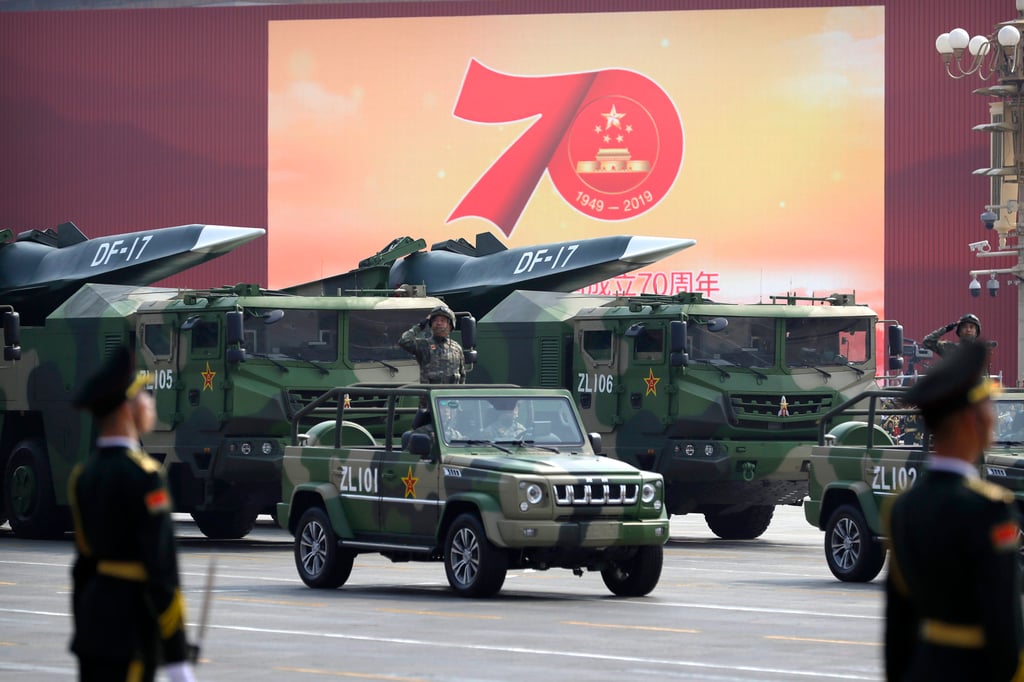
President Xi Jinping has had a hand in shaping public consciousness, for instance by celebrating “strategic scientists”, like the late Qian Xuesen who was pivotal to China’s missile programme. While previous leaders such as Deng Xiaoping and Jiang Zemin have sometimes linked China’s nuclear arsenal to a national sense of greatness, Xi goes further.
Advertisement
Select Voice
Choose your listening speed
Get through articles 2x faster
1.25x
250 WPM
Slow
Average
Fast
1.25x