

-
Advertisement
South China Sea
Opinion
Bonnie Glaser
Jeff W. Benson
Bonnie GlaserandJeff W. Benson

Opinion | Conflict prevention in the South China Sea depends on China abiding by the existing rules of navigation

  • US freedom of navigation operations do not, in and of themselves, raise the risk of a maritime incident
  • From the 1972 ‘Rules of the Road’ to the 2014 bilateral agreement on the rules of behaviour, the protocol exists for peaceful engagement even in disputed waters
Reading Time:4 minutes
Why you can trust SCMP
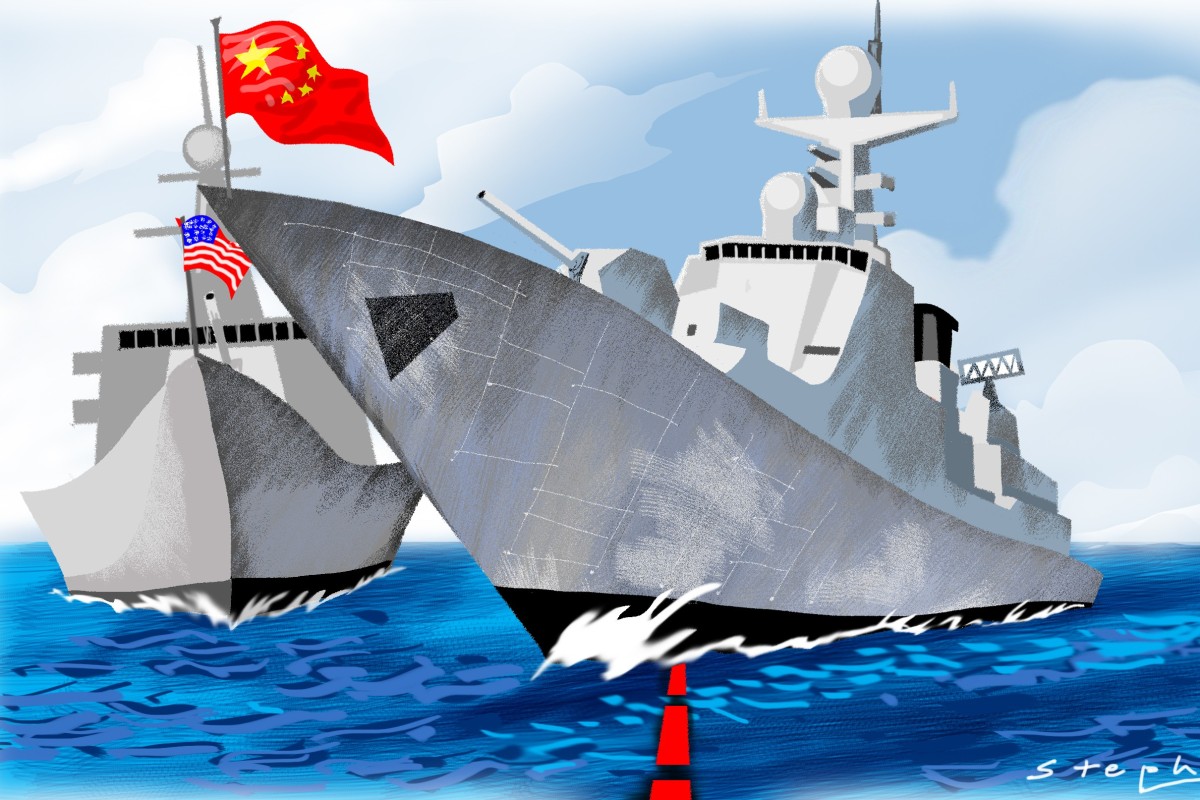
Illustration: Craig Stephens

If China truly wants to coexist and compete peacefully in the Indo-Pacific, it must comply with international treaties and agreements.

This includes international accords that apply to the disputed waters of the South China Sea, where the risk of an incident is growing, not only between the US and China, but also between China and its neighbours. China’s flouting of international rules in the South China Sea may spark a future maritime incident.

Some Chinese charge that the United States is increasing the potential for a dangerous encounter by sailing navy vessels close to rocks or artificial islands controlled by China. That argument was made by Senior Colonel Zhou Bo, an official in China‘s Ministry of Defence, in a recent New York Times column.

Advertisement
Such US operations are part of the Pentagon’s global freedom of navigation programme, which is aimed at preserving freedom of navigation by sailing in areas where states have made excessive maritime claims or are imposing illegal restrictions on freedom of navigation. China was among 26 claimants challenged in 2018, three of which were US treaty allies.
US Navy freedom of navigation operations, do not ipso facto raise the risk of an accident. Rather, it is Chinese actions that contravene international law that increase the potential for a collision.

For example, when the US Navy destroyer USS Decatur conducted a freedom of navigation operation in the vicinity of Gaven Reef in the South China Sea in September 2018, the Chinese Luyang II destroyer Lanzhou approached the US destroyer on its port side and closed dangerously within 41 metres (45 yards).
Advertisement
Select Voice
Choose your listening speed
Get through articles 2x faster
1.25x
250 WPM
Slow
Average
Fast
1.25x