Advertisement

Opinion
Hong Kong has seen three kinds of violence, all facets of one fundamental problem
- The Hong Kong government lacks both democratic accountability and an ability to champion local interests. The source of the current violence is institutional – addressing it is the only way to end the unrest
3-MIN READ3-MIN

Jason Buhi teaches constitutional law at the Barry University Dwayne O.
At a recent press briefing addressing Hong Kong’s summer of protest, Beijing’s spokesman repeatedly stated that “violence is violence” – a simplistic aphorism on a par with “one country, two systems” in terms of capacity for obscuration.
There are fundamental differences between violence against property, physical violence, and institutional violence. Violence against property is vandalism and results in money damages. Physical violence occurs when someone uses or threatens to use their body or a weapon to control another person’s actions. It can result in pain, injury, or death. Institutional violence refers to public institutions harming society by denying popular will and obstructing access to basic necessities. It is insidious and fuels popular unrest.
All three forms of violence have been witnessed in Hong Kong, but not in equal measure. Institutional violence is the fundamental problem, and alleviating it is the only way to cure all three.
Violence against property is not a serious concern here, as the vast majority of local demonstrators are remarkably civil. Rally participants set up recycling stations and some even return to pick up litter after being dispersed by police. Where significant vandalism has occurred, the targets have been limited to the perceived symbols of institutional violence: the accoutrements of local pro-establishment politicians and the central government’s coat of arms.
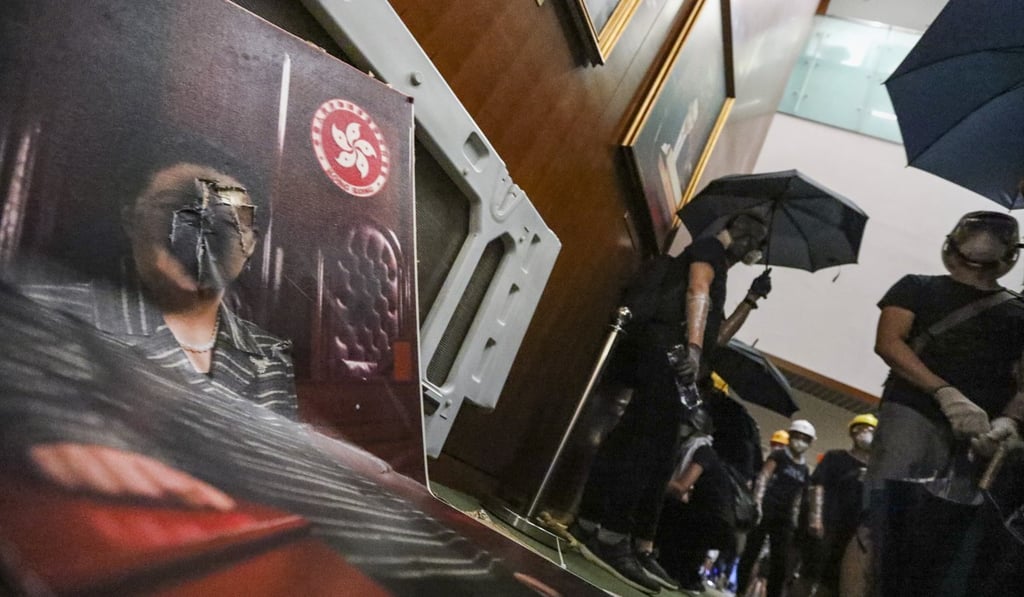
Meanwhile, the threat of physical violence has risen to dangerous levels. The police triggered an escalation by crushing a modest rally with overwhelming force on June 12, firing almost twice as many tear gas canisters in a single day than were launched in 2014. Some protesters have since sought to steel themselves against physical violence from the police and local triad gangs by improvising defences against salvoes of tear gas, rubber bullets, and batons.
Advertisement
Select Voice
Select Speed
1.00x